
GRAM brings stochastic reasoning to recursive neural networks
Yoshua Bengio and collaborators at KAIST and NYU introduced GRAM, a recursive reasoning architecture that adds controlled randomness to explore multiple solution paths without expanding context, scoring 52% on ARC-AGI.
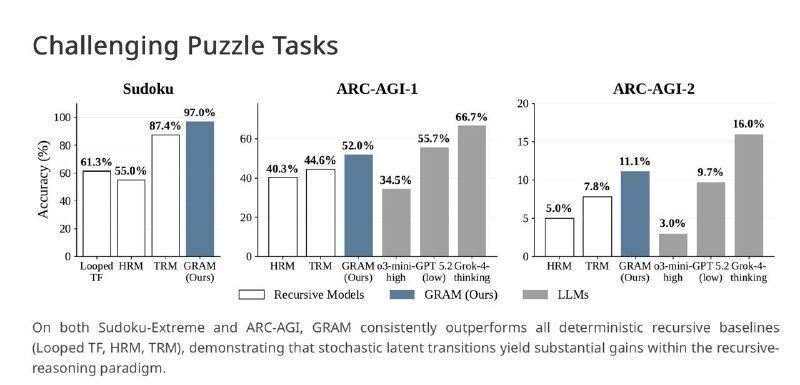
Yoshua Bengio, co-creator of the attention mechanism, has unveiled GRAM—Generative Recursive reAsoning Models—in collaboration with researchers at KAIST and New York University. The architecture addresses a fundamental limitation in recursive reasoning models: their deterministic nature, which forces them to follow a single solution path for any given input.
Recursive reasoning models have been explored as an alternative to chain-of-thought approaches. Instead of generating additional tokens to reason through a problem, these models iterate internally, refining hidden states to improve answers. The theoretical advantage is clear—hundreds of reasoning steps without bloating the context window. But until now, every recursive model has been deterministic: same input, same path, same answer.