

Claude writes 80% of Anthropic's production code; agents outpace humans on research tasks
Anthropic disclosed that Claude now writes over 80% of code merged into production as of May 2026, with engineers merging 8× more code per day than in 2024. In internal experiments, AI agents improved a safety research task by 97% in one week—far outpacing human researchers.
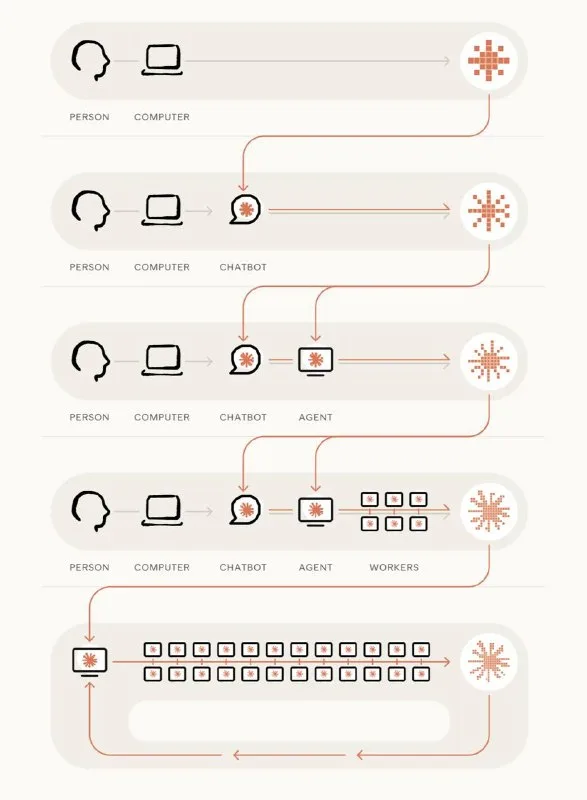
Anthropic disclosed this week that Claude now writes more than 80 percent of the code merged into its production codebase as of May 2026. Engineers at the company are merging eight times more code per day than they did in 2024, with the model automating the bulk of implementation work that feeds into training the next version of Claude itself.
The company framed the milestone as evidence that recursive self-improvement—the concept of a model training its own successor—is no longer theoretical. Humans still hold an edge in setting research direction and evaluating taste, but Claude handles the majority of the execution loop that produces the next Claude.
What stands out
- 01Code velocity jumped 8× in two years. A typical Anthropic engineer merged eight times as much code per day in Q2 2026 as in 2024, with Claude writing the lion's share of new lines.
- 02Agents outpaced humans on a safety research task. In an internal experiment, two human researchers improved a solution by 23 percent over one week; agent-driven workflows improved the same task by 97 percent in the same span.
- 03The model trains itself. Claude automates most of the work that goes into building the next Claude—data pipelines, eval harnesses, training code—closing the recursive loop faster than Anthropic anticipated.
- 04Anthropic wants coordination mechanisms. The company wrote that the pace is faster than expected and that the world may need mechanisms to slow or pause frontier development if recursive loops accelerate further.
- 05Research taste is the last human moat. Humans still excel at choosing which problems to solve and which metrics matter, but that advantage narrows as agents get better at exploring solution spaces under a fixed objective.


