Ideogram-4 open weights challenge FLUX and Hunyuan at 9.3B parameters
Ideogram released open-weight Ideogram-4, a 9.3-billion-parameter text-to-image model available in fp8 and nf4 quantizations. The company claims state-of-the-art results among open-source alternatives and competitive quality with closed APIs, despite a smaller footprint than FLUX-2-dev and Hunyuan-Image-3.
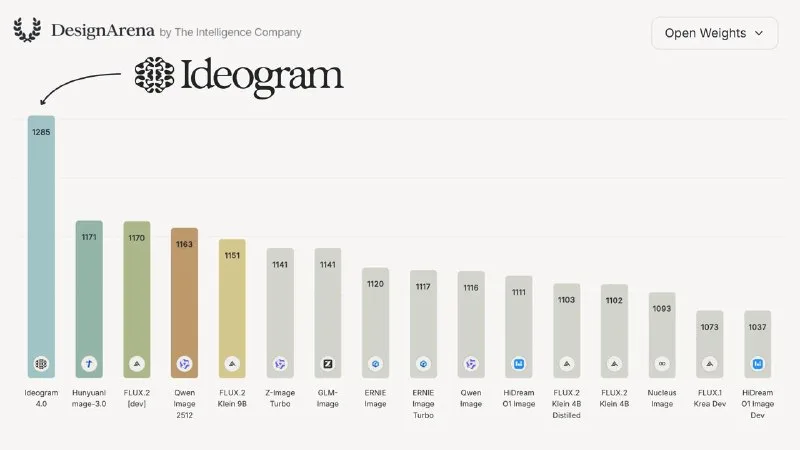
Ideogram released open weights for Ideogram-4, a 9.3-billion-parameter text-to-image model, this week in fp8 and nf4 quantized formats. The company claims it achieves state-of-the-art results among open-source models and approaches the quality of leading closed APIs, despite a smaller parameter count than competitors like FLUX-2-dev, Hunyuan-Image-3, and Qwen-Image. The weights are available on HuggingFace.
The model uses a single-stream DiT architecture paired with the Qwen-3-VL-Instruct encoder. A key architectural difference: training and inference both operate on structured JSON captions rather than plain-text prompts. This departure from the free-form caption pipelines most diffusion models use gives fine-tuners explicit control over metadata like aspect ratio, style tags, and composition hints, though it may complicate drop-in use with existing txt2img pipelines.
License and commercial use
Ideogram-4 ships under a non-commercial license, restricting use to research and personal projects. Commercial deployment requires a separate agreement with Ideogram. The restriction applies to both the base weights and any fine-tunes derived from them.
The 9.3-billion-parameter footprint places Ideogram-4 in the same weight class as earlier FLUX variants. According to the company's benchmarks, it closes much of the gap with heavier models—a significant claim if validated, given the efficiency gains for practitioners running inference on consumer hardware.