

Nobel physicist Parisi credits Claude in formal proof collaboration
Giorgio Parisi, 2021 Nobel laureate in Physics, published a preprint crediting Anthropic's Claude Sonnet 4.6 and Opus 4.7 as collaborators in developing and verifying a mathematical proof.
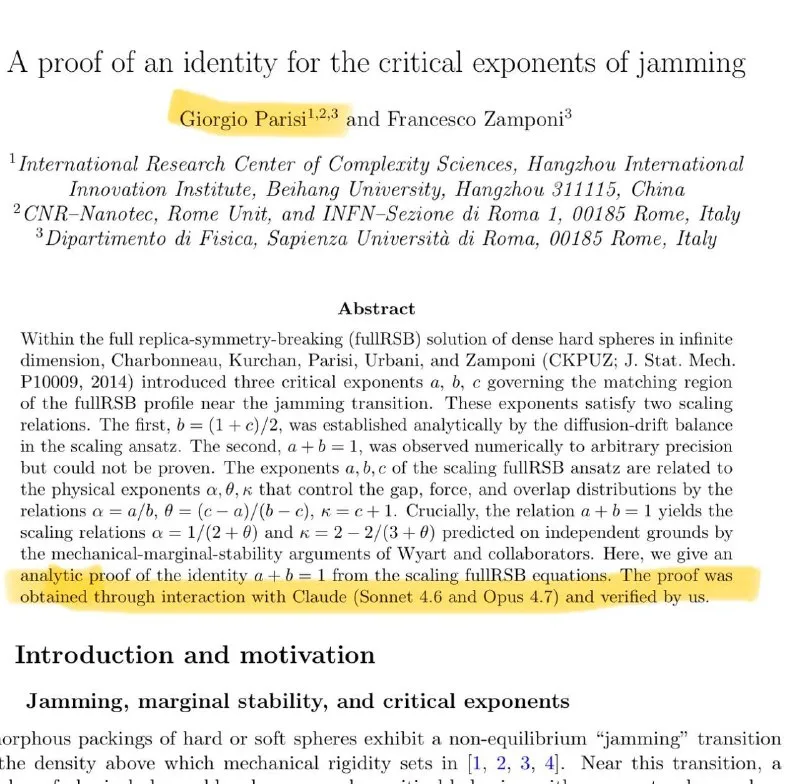
Giorgio Parisi, the 2021 Nobel Prize winner in Physics, published a new preprint this week that credits Anthropic's Claude models—Sonnet 4.6 and Opus 4.7—as collaborators in producing and verifying a mathematical proof. The paper, posted to arXiv on June 8, marks one of the first instances of a Nobel laureate formally acknowledging an AI system's role in theorem development.
Parisi's group states the proof "was obtained through interaction with Claude (Sonnet 4.6 and Opus 4.7) and verified by us." The preprint does not detail which portions Claude generated versus which the human authors contributed, but the acknowledgment suggests the AI handled substantive reasoning steps rather than formatting or literature search.
What stands out
- 01First Nobel-tier formal credit. While researchers have used LLMs for code generation and literature review, a Nobel laureate naming an AI model as a proof collaborator in the author line or acknowledgments is unprecedented in physics.
- 02Two Claude versions in tandem. The team used both Sonnet 4.6 (Anthropic's faster mid-tier model) and Opus 4.7 (the flagship reasoning model), suggesting they leaned on Opus for the hardest steps and Sonnet for iteration.
- 03Human verification emphasized. The phrase "verified by us" underscores that the human authors checked the AI's output line-by-line—a necessary step given that LLMs can still hallucinate intermediate claims in formal proofs.
- 04Preprint stage, not yet peer-reviewed. The paper has not passed journal peer review. Reviewers will likely scrutinize whether the proof's novelty lies in the mathematical result itself or in demonstrating that Claude can handle graduate-level theorem proving.


