

Anthropic splits Claude into Fable 5 and Mythos 5 for creative and analytical tasks
Anthropic announced Claude Fable 5 and Mythos 5, two new models designed for creative and analytical workloads respectively, marking a shift toward use-case-specific positioning rather than universal version upgrades.
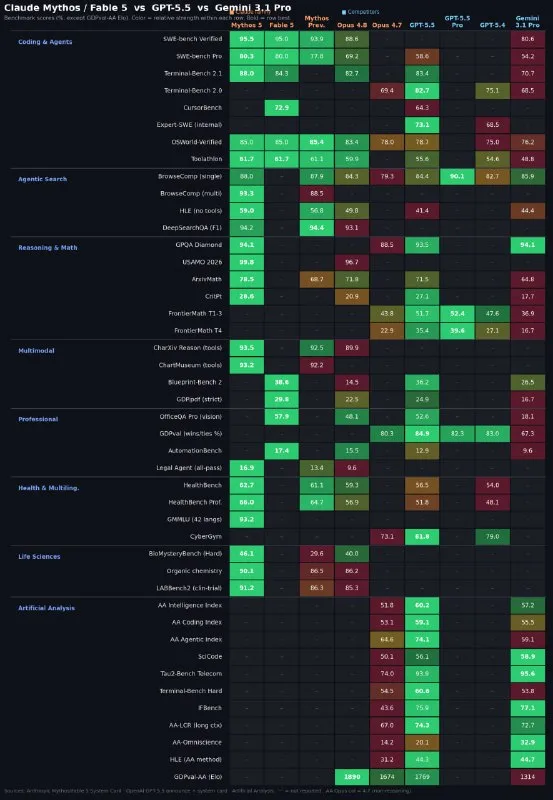
Anthropic released Claude Fable 5 and Claude Mythos 5 on June 9, two new additions to its Claude model family. Fable 5 is optimized for creative tasks—story generation, dialogue writing, and narrative-heavy workflows—while Mythos 5 targets analytical reasoning, structured problem-solving, and technical documentation. Both are available through Anthropic's API and the Claude web interface, with per-token pricing scaling by model size and context window.
The company has not disclosed parameter counts or training datasets for either model, maintaining its pattern of withholding architectural details. Neither model is open-weight; both run exclusively on Anthropic's infrastructure with server-side safety enforcement. Anthropic's announcement includes sample outputs and benchmark comparisons against prior Claude versions, though no third-party evaluations or reproducible test suites have surfaced yet.
Task-specific segmentation
Fable 5 and Mythos 5 mark Anthropic's first model launch using explicitly task-oriented naming rather than version numbers. The shift signals a move toward segmenting the model lineup by use case rather than treating each release as a universal upgrade. Fable 5's creative focus overlaps with existing Claude Opus capabilities, while Mythos 5 appears positioned to compete with OpenAI's o1 reasoning models and Google's Gemini Pro.
Developers testing the models report that Fable 5 handles long-form fiction prompts with fewer repetition loops than Claude 3.5 Sonnet, while Mythos 5 shows stronger performance on multi-step math and code debugging tasks.


