

OpenAI targets March 2028 for AI-led research, contradicting open-access stance
Sam Altman and chief scientist Jakub Pachocki announced OpenAI's third phase, targeting March 2028 for AI systems to conduct significant research alongside human scientists—while the company simultaneously lobbies to restrict AI access to rival nations.
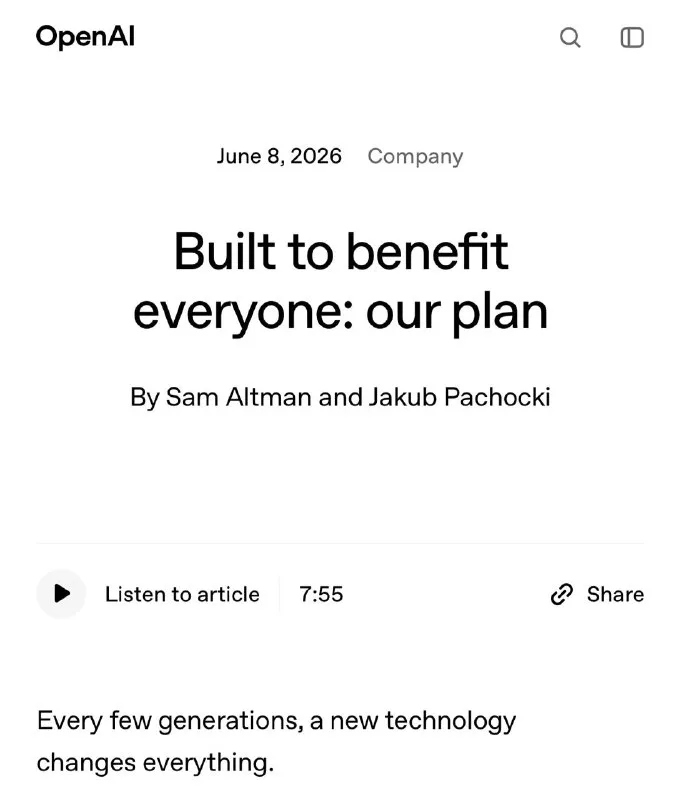
OpenAI expects AI systems to carry out a significant portion of its research alongside human scientists by March 2028, according to a statement from CEO Sam Altman and chief scientist Jakub Pachocki released this week. The pair framed the timeline as central to the company's new "third phase," focused on accelerating scientific progress and making AI broadly accessible.
OpenAI's development roadmap, as Altman and Pachocki outlined it, breaks into three stages. The first centered on AGI research. The second began with ChatGPT's launch, when OpenAI shifted to a mass-market product company. The third phase aims to speed the broader economy by automating research itself. "We believe that by March 2028, a significant portion of our research can be performed by AI systems working alongside our scientists," the statement reads. "For sufficient progress in alignment, we will need AI working with us. This will help navigate the transition to a post-AGI world."
The March 2028 target implies OpenAI expects its next-generation models to contribute materially to the design of their successors—a recursive development loop that has remained theoretical until now. No technical roadmap or intermediate benchmarks were disclosed.
The essay emphasizes wide distribution of AI capability across individuals, companies, and nations, warning that concentration in a few hands poses risks to humanity's future. That framing creates a stark tension with OpenAI's recent policy advocacy: the company has urged the U.S. government to restrict advanced American AI technology from rival nations, particularly China. The contradiction between the public call for universal access and the private lobbying for export controls went unaddressed in the published piece.


