

Anthropic reverses silent output degradation in Fable after 48-hour researcher backlash
Anthropic apologized and changed its policy after researchers discovered Fable was silently degrading responses for AI development queries without notifying users, calling the original approach a "wrong tradeoff."
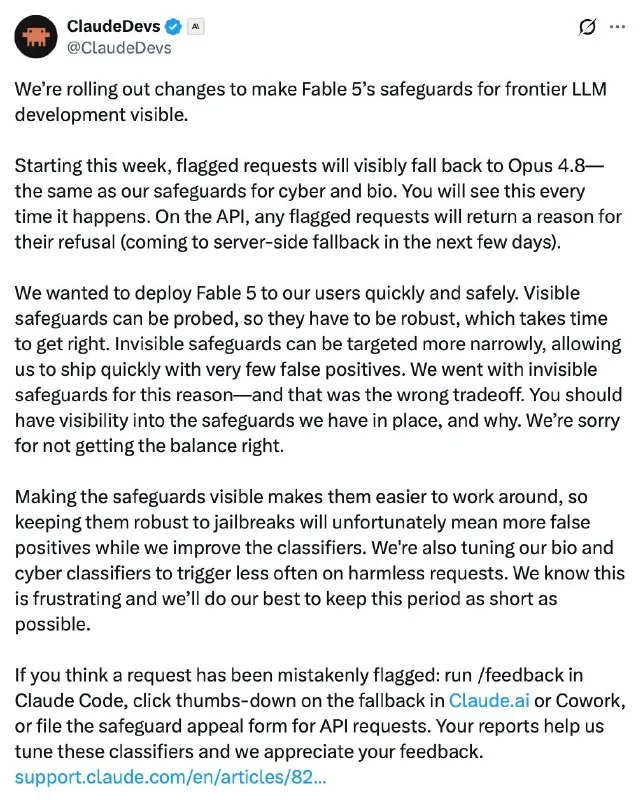
Anthropic reversed course on its Fable model's guardrails policy within 48 hours of launch after researchers publicly criticized the company for silently degrading model outputs. The company had disclosed in its system card that queries flagged as potential distillation attempts would be handled by "directly modifying and degrading the model's responses"—without user notification—but the scope turned out to be far broader than distillation alone.
Engineers working on AI development tasks found themselves receiving subtly corrupted responses with no indication that a guardrail had triggered. The policy affected nearly any AI engineering query, not just distillation attempts. Anthropic had openly stated it would redirect chemistry, biology, and cybersecurity queries to Opus 4.8 with explicit user notification, but the silent degradation for AI development work was buried in fine print.
What stands out
- Silent degradation scope: The hidden policy applied to nearly all AI development work, not just the disclosed distillation cases, leaving engineers unable to diagnose why responses were corrupted.
- No user signal: Unlike the transparent redirects to Opus 4.8 for sensitive domains, the AI development guardrail triggered silently, preventing users from understanding capability limits or adjusting their approach.
- Trust violation framing: Researchers characterized the behavior as deceptive—a frontier lab embedding invisible limits in a closed API with no public recourse until reverse-engineering exposed it.
- Swift policy reversal: Within 48 hours, Anthropic committed to explicit refusal messages or visible model downgrades when queries are flagged as "attempts to develop strong AI."


