

DeepMind maps four technical paths to superintelligence, constrained by data walls and physics
Google DeepMind researchers published a formal framework analyzing the transition from human-level AGI to artificial superintelligence, identifying four technical pathways constrained by six structural limits including data walls and physical compute bounds.
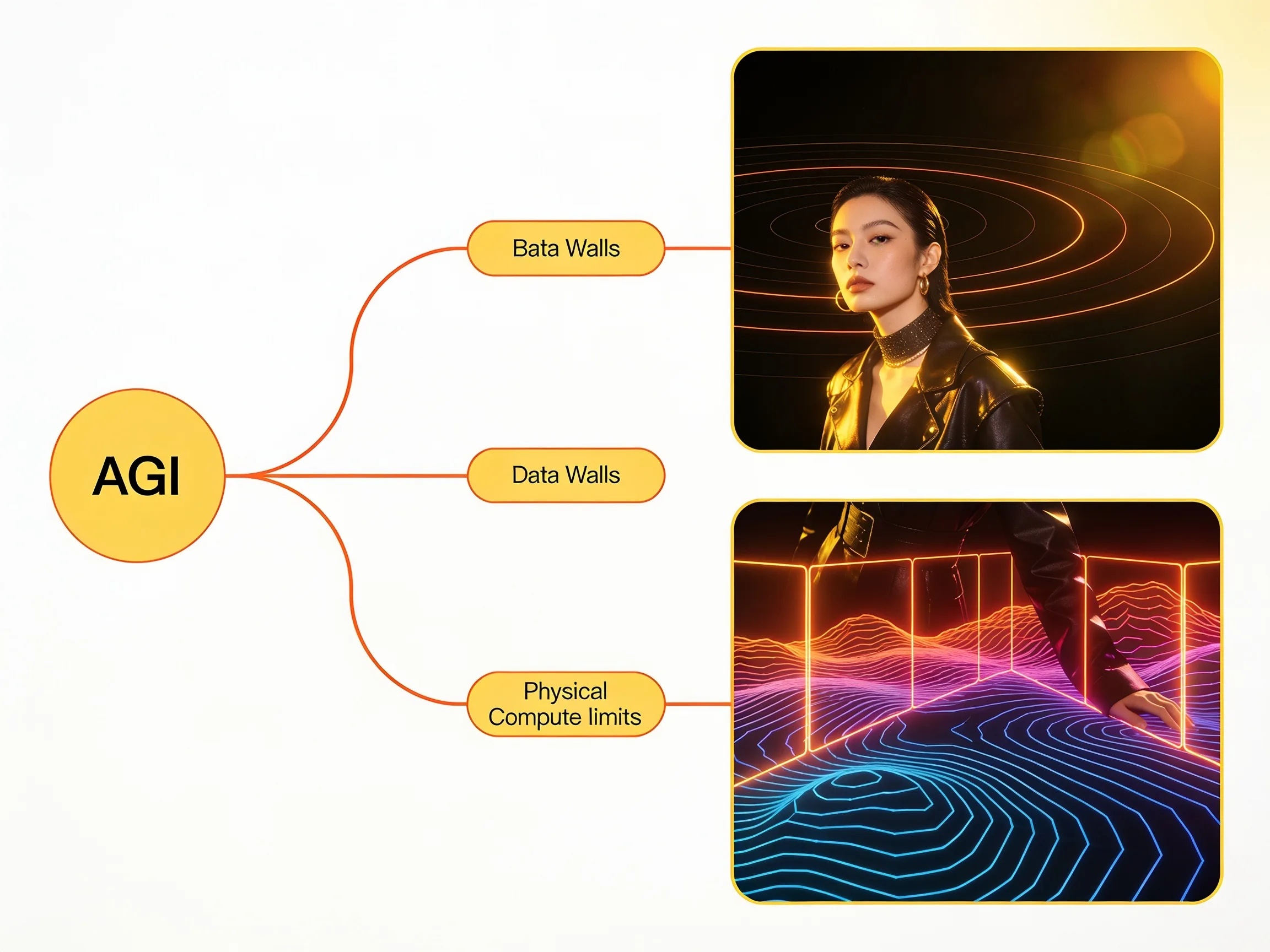
Google DeepMind released a preprint this week laying out a formal framework for the jump from artificial general intelligence to superintelligence. The paper, titled "From AGI to ASI," names four technical pathways and six structural constraints that will shape machine intelligence beyond the human-level threshold. Lead author Tim Genewein and a team of fourteen DeepMind researchers argue that post-AGI progress won't follow the exponential curves of pre-AGI scaling — instead, physical limits, data exhaustion, and economic friction will force architectural pivots.
The preprint identifies recursive self-improvement, multi-agent systems, and test-time compute optimization as the three routes most likely to push systems past AGI once pre-training data runs dry. The authors call the data exhaustion point the "information wall" — a term borrowed from earlier scaling debates — and note that inference-time search and agent coordination become the primary levers when you can't add another trillion tokens. A fourth pathway, continued brute-force scaling, is acknowledged but treated as the least sustainable option given energy and chip supply constraints.
Six structural limits
DeepMind's framework names six hard constraints: the information wall (finite high-quality training data), physical compute ceilings (chip fabrication and energy grids can't scale infinitely), algorithmic efficiency plateaus (diminishing returns on architecture tweaks), economic feasibility (training runs already cost hundreds of millions), safety and alignment overhead (each capability jump requires new guardrails), and coordination failures in multi-agent setups. The paper argues that any realistic ASI timeline must account for all six simultaneously, not just Moore's law projections.
The preprint is available on arXiv at abs/2606.12683. No code or model weights accompany the release — this is a conceptual and theoretical piece, not an empirical benchmark study. The authors position the work as a research agenda rather than a prediction, explicitly rejecting "singularity" narratives in favor of an engineering roadmap grounded in known physical and economic constraints.


