

Data2Story chains seven AI agents into a fact-checked newsroom for datasets
A new open-source multi-agent pipeline for Claude Code transforms raw data into narrative HTML stories with inline citations, automating the editorial workflow from analysis through fact-checking.
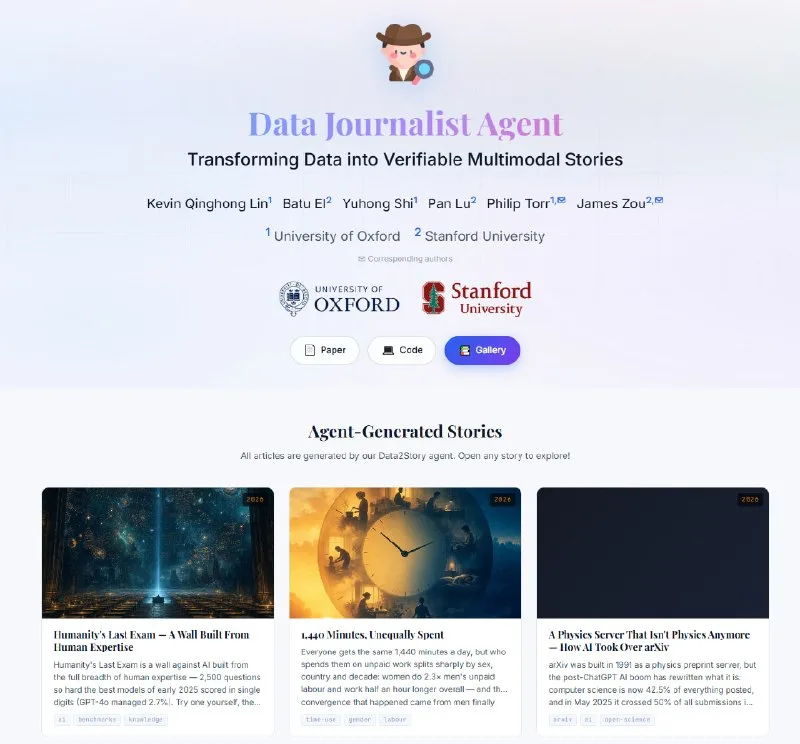
Data2Story is an open-source multi-agent pipeline that converts datasets into narrative HTML reports with inline citations. The system runs as a skill for Claude Code and Codex, orchestrating seven specialized agents that each handle one stage of the editorial process—positioning itself as a "virtual newsroom" that automates the fact-checking and sourcing workflow typically handled by human journalists.
The workflow begins with a Detective agent that searches external context for the data's history and significance. An Analyst agent then examines distributions, correlations, trends, and outliers within the dataset. An Editor agent selects the narrative arc and key findings, while a Designer agent chooses visualizations—charts, images, video embeds, and interactive elements. A Programmer agent assembles the final HTML document and tags every claim with a source link. An Auditor agent fixes layout issues like spacing and alignment, and an Inspector agent verifies that each assertion is backed by evidence, producing an interactive viewer for the proof chain.
The approach reflects a broader trend in open-source AI tooling: breaking complex tasks into role-specific agents rather than prompting a single model to handle everything. Multi-agent systems like AutoGPT, MetaGPT, and CrewAI have gained traction over the past year for code generation, research synthesis, and content workflows. Data2Story applies the same architecture to data journalism, a domain where provenance and citation are non-negotiable. The code is available on GitHub under an open license, with documentation and examples showing the seven-agent chain processing sample datasets into fully cited HTML reports.


