

GPT-5.4 powers autonomous AI chemist to optimize drug synthesis
OpenAI and Molecule.one demonstrated a near-autonomous AI chemist powered by GPT-5.4 that improved a challenging drug synthesis reaction, marking a step toward automated medicinal chemistry workflows.
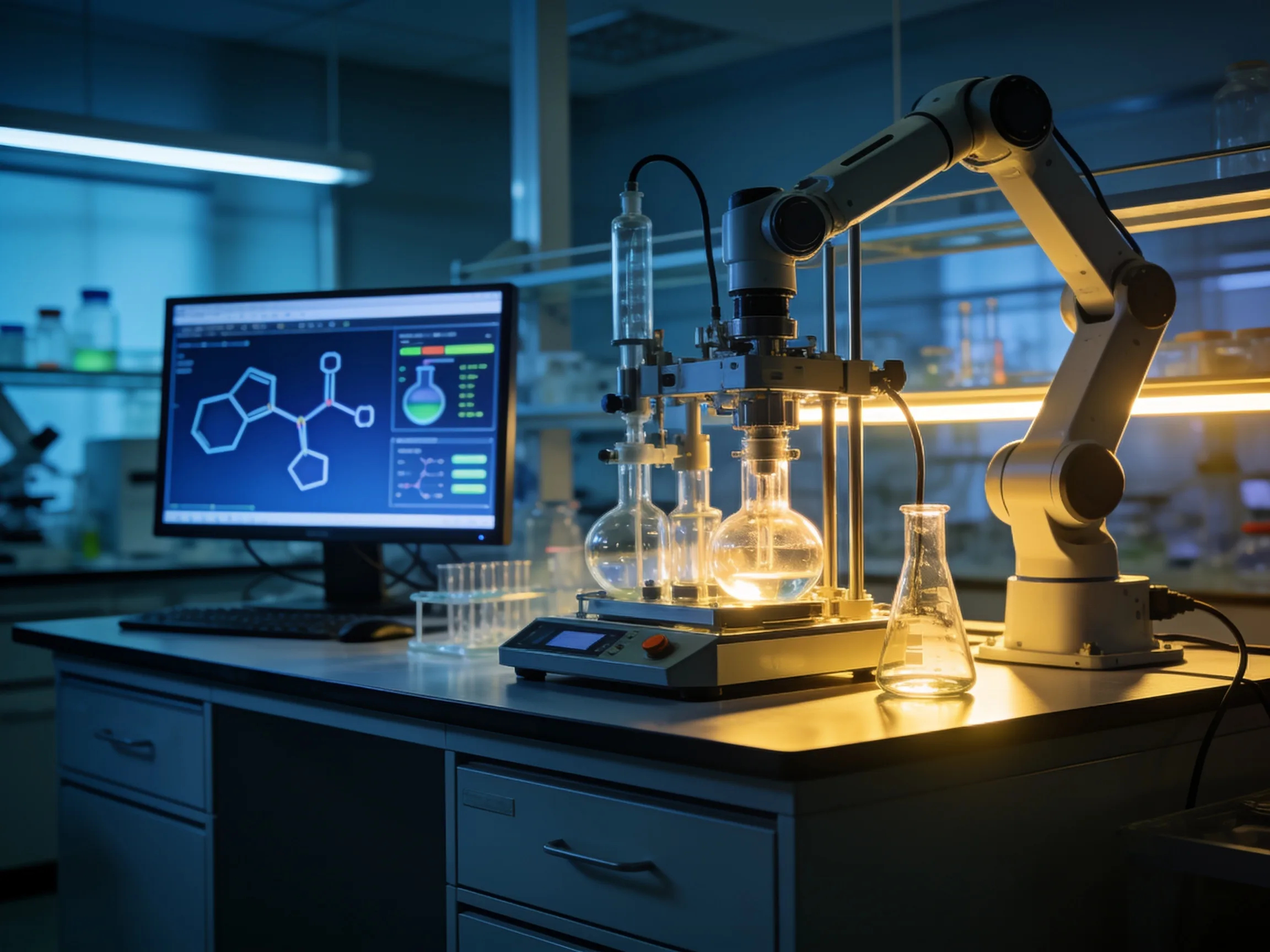
OpenAI and Molecule.one demonstrated a near-autonomous AI chemist powered by GPT-5.4 that improved a challenging drug synthesis reaction. The system autonomously designed and executed experiments to optimize a key step in medicinal chemistry, reducing the need for manual trial-and-error by human researchers.
The collaboration targeted a reaction commonly used in pharmaceutical development but known for low yields and difficult optimization. The AI chemist proposed modifications to reaction conditions, selected reagents, and iteratively refined the protocol based on experimental feedback. The system achieved measurable yield improvements over the baseline, though specific percentage gains were not disclosed.
System architecture
The AI chemist operates by interfacing GPT-5.4 with laboratory automation hardware. It reads literature, proposes hypotheses, designs experiments, and interprets results in a closed loop. Molecule.one's synthesis planning platform provided the chemical reasoning layer, while GPT-5.4 handled natural-language task planning and decision-making. The system required minimal human intervention once initialized, completing multi-step optimization cycles without manual adjustments.
The work builds on earlier efforts to automate chemical discovery but represents a shift toward end-to-end autonomy in medicinal chemistry. Reaction optimization remains a persistent bottleneck in drug development. The companies did not announce a commercial product or release the underlying model weights.


