

Claude Opus 4.7 autonomously trains robot dog to fetch in under two hours
Anthropic's Claude Opus 4.7 connected to a quadruped robot, wrote control code, and trained it to retrieve a ball without human intervention—completing the task roughly 20 times faster than the best human team achieved in 2024.
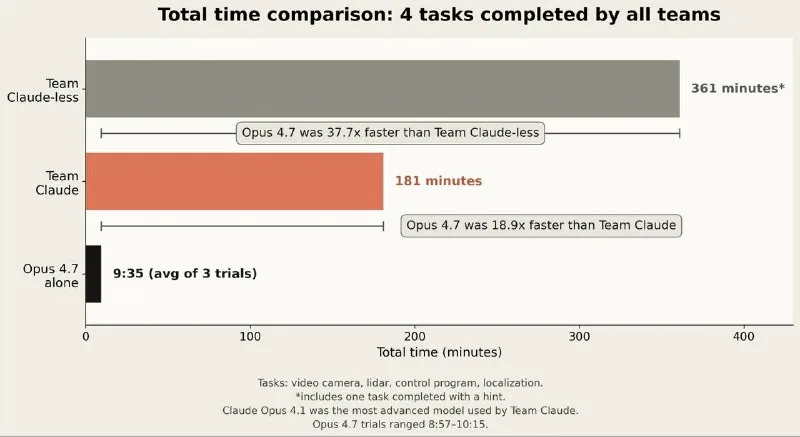
Anthropic's Claude Opus 4.7 has completed a robotics task that its predecessor could not solve and that outpaced human engineers by a factor of 20. The model autonomously connected to a quadruped robot, mapped its sensors and cameras, wrote control code from scratch, and trained the machine to fetch a ball—all without human intervention.
The achievement is framed as "Project Fetch Phase Two," a direct sequel to a 2024 experiment in which two teams of non-robotics engineers raced to teach the same robot dog the same trick. One team had access to Claude; the other did not. The AI-assisted group finished faster, but Claude itself couldn't solve the problem end-to-end—it stalled during the initial connection phase and required constant human debugging.
Two years later, Opus 4.7 handled the entire pipeline autonomously, from hardware handshake to motion planning, in roughly one-twentieth the time the best human team logged in 2024. The 2024 baseline involved teams working over multiple days; the 2026 run took hours. Claude Opus 4.7 wrote Python control scripts, debugged sensor input mismatches, and iteratively tuned the fetch behavior until the robot reliably retrieved the ball and returned it to a marked position.
Anthropic released no weights or API access details for the robotics-specific version of Opus 4.7 used in the demo. The company's research writeup emphasizes the speed gain and the zero-shot nature of the task—Claude received no prior training on this specific robot model and no human-written starter code. The model inferred the control API from documentation files and sensor logs, then generated working motion primitives on the first deployment attempt. Anthropic frames the milestone as an example of autonomous AI training autonomous systems now crossing into physical hardware, not just simulation or code generation.


