

Claude integrates HeyGen HyperFrames for text-to-video and HTML rendering
Anthropic integrated HeyGen's HyperFrames video-processing toolkit into Claude, enabling text-to-video and HTML-to-video rendering directly within the platform.
Anthropic has wired HeyGen's HyperFrames video-processing framework into Claude, letting developers generate and manipulate video directly from Claude's interface or API. The integration treats video creation as a native capability alongside text and code generation.
HyperFrames is a developer toolkit from HeyGen, the avatar and video synthesis company, designed to handle video input and output within AI workflows. The framework supports text-to-video and HTML-to-video rendering—the latter particularly useful for turning styled HTML documents, dashboards, or web mockups into rendered video clips without manual screen recording. Developers can now call HyperFrames functions directly from Claude rather than making separate API calls to a third-party service.
The move positions Claude against other multimodal platforms that have added video capabilities over the past year. OpenAI's GPT-4 with vision can analyze video frames but doesn't natively generate video; Google's Gemini has video understanding but similarly lacks built-in synthesis. By integrating HyperFrames, Anthropic is betting that developers want video creation as a first-class tool.
HeyGen has traditionally focused on avatar-driven video for enterprise use cases—sales outreach, training modules, localized marketing content. HyperFrames extends that into a general-purpose framework. The tagging around agent workflows suggests the framework is positioned for agentic systems that need to produce video artifacts on the fly: sales demos, explainer clips, dynamic social media content—all without manual editing.
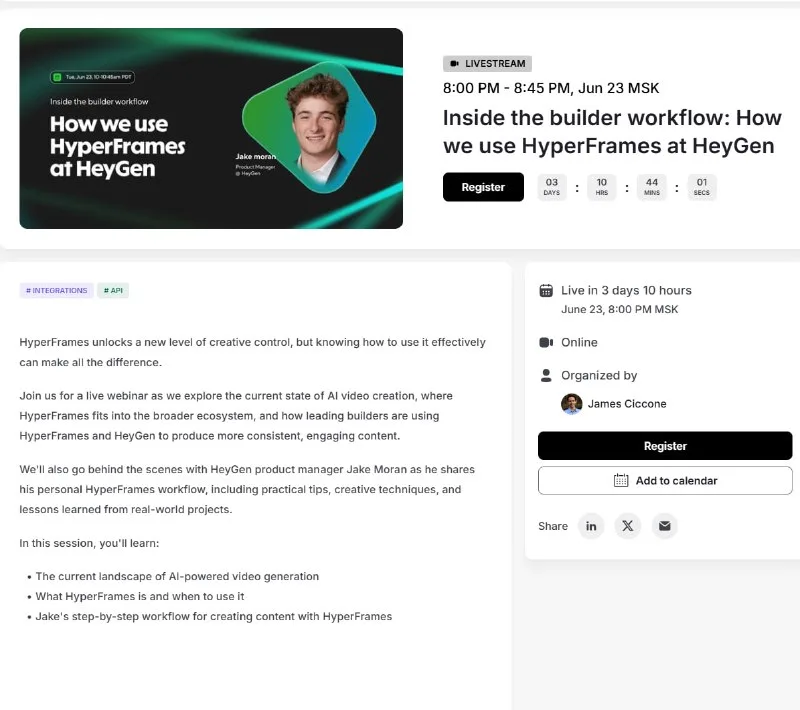
Anthropic is hosting a livestream walkthrough on June 23 covering practical use cases and implementation patterns. No pricing details or access restrictions were disclosed in the initial announcement, though HeyGen's existing products typically run on usage-based billing.


