

OTUS free LLM workshop covers RAG and LoRA design tradeoffs
Russian online education platform OTUS hosts a free workshop on retrieval-augmented generation and parameter-efficient fine-tuning ahead of its expert-level LLM course launch.
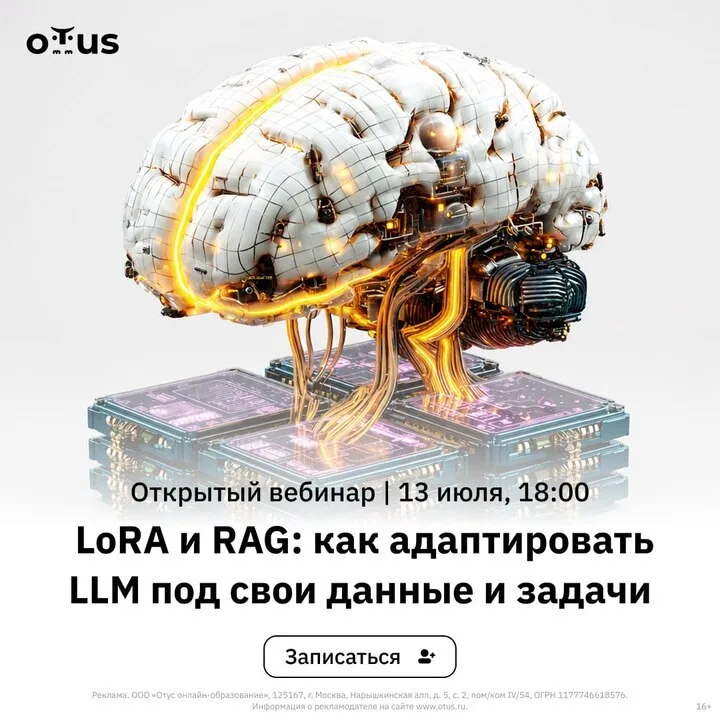
OTUS, a Moscow-based online education provider, is running a free workshop on large language model architecture decisions July 13 at 18:00 MSK. The session covers retrieval-augmented generation (RAG) for grounding model outputs in external documents, low-rank adaptation (LoRA) for efficient fine-tuning, and when to combine both approaches. The workshop targets data scientists, ML engineers, and IT professionals working with text data who want to deploy LLM solutions with a clear understanding of the underlying design choices.
RAG has become the default pattern for connecting LLMs to proprietary knowledge bases without retraining base weights—companies from legal research platforms to customer support systems now route user queries through vector databases before hitting the model. LoRA, introduced in 2021, has emerged as the standard for parameter-efficient fine-tuning, letting practitioners adapt 7B-70B models on consumer GPUs by training low-rank decomposition matrices instead of full weight updates. The workshop's focus on when to use each technique—and when to stack them—addresses a live question for teams moving from proof-of-concept demos to production systems. Registration opens on the OTUS platform; the session precedes the launch of OTUS's "Large Language Models: Expert Level" paid course.


