

Physics-guided CNN predicts phase separation while preserving mixture composition
Researchers propose an attention-based convolutional neural network surrogate that learns microstructural evolution in binary mixtures, preserving composition and matching Lifshitz-Slyozov domain-growth law.
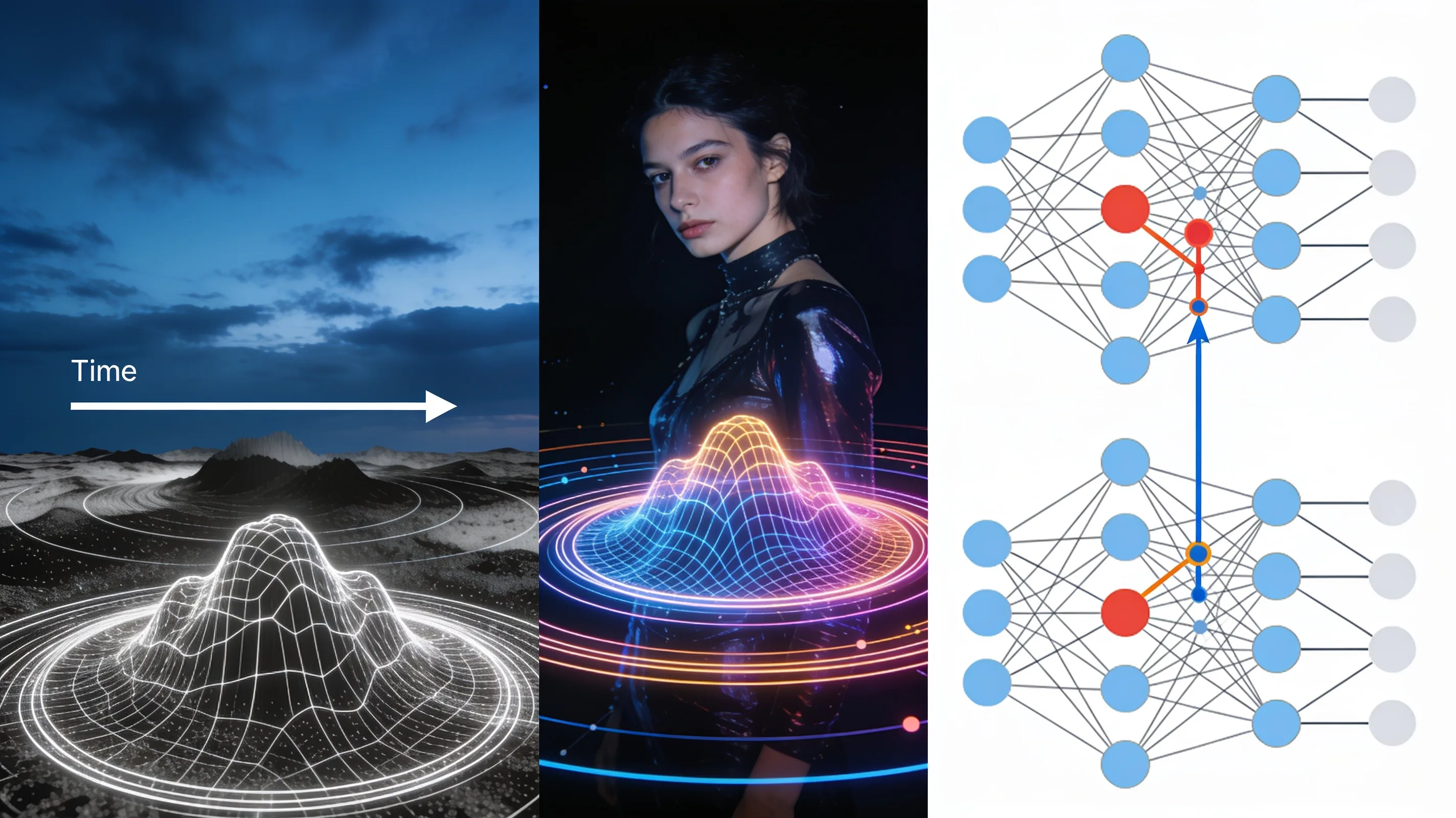
A new attention-based convolutional neural network offers a computationally efficient surrogate for predicting phase separation in binary mixtures governed by the Cahn-Hilliard equation. The model learns the spatiotemporal evolution of systems with conserved kinetics and produces stable predictions over long time horizons for both critical and off-critical mixture compositions. Traditional numerical solvers for nonlinear partial differential equations remain computationally expensive; the physics-guided deep learning approach maintains physical consistency while reducing computational cost.
The trained surrogate preserves mixture composition throughout evolution and accurately captures domain size growth consistent with the Lifshitz-Slyozov domain-growth law, a well-established scaling relationship in coarsening systems. The attention mechanism and physics-guided architecture enable stable long-rollout predictions without the drift or instability that often plague purely data-driven methods. The framework extends beyond binary phase separation to other complex dynamical systems, with potential applications in materials science, chemical engineering, and biological pattern formation.


