

Flow Reasoning Models verify constraint solutions via fixed-point geometry, cut inference 8× versus diffusion
Researchers propose Flow Reasoning Models, a framework that treats discrete flow networks' own denoising trajectories as unsupervised verifiers, achieving near-perfect accuracy on Sudoku and Zebra puzzles while cutting inference cost 8× versus masked diffusion baselines.
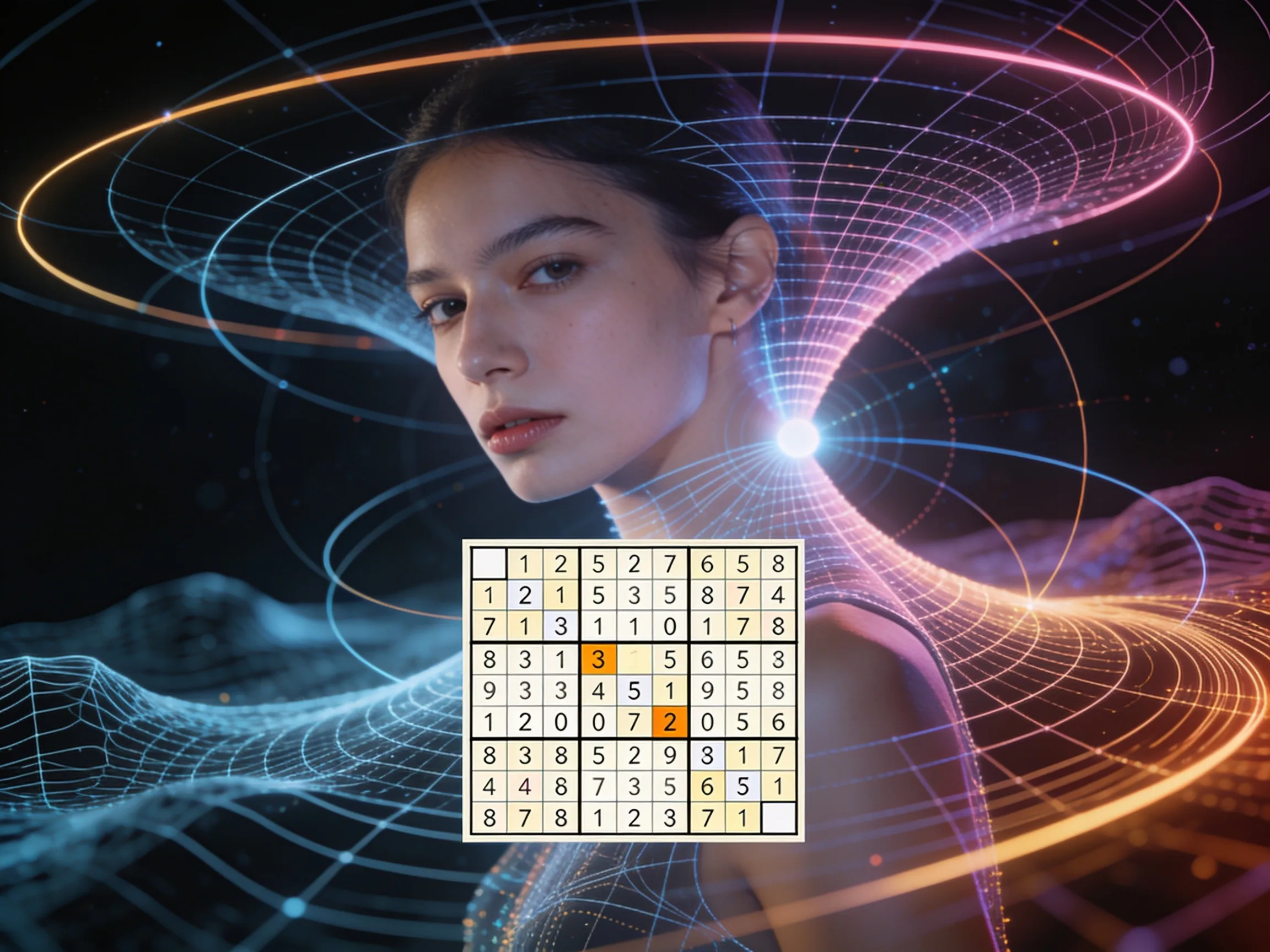
Flow Reasoning Models (FRM) is a test-time scaling framework from Alec Helbling, Andrey Bryutkin, Mauro Martino, Nima Dehmamy, and Hendrik Strobelt that solves structured constraint-satisfaction problems—Sudoku, logic puzzles, Zebra riddles—by letting discrete flow networks verify their own outputs. The core insight: when a flow model's denoising trajectory converges to a fixed point in embedding space, that geometric stability itself signals a correct solution. The team measured AUROC near 1.0 for this self-verification signal, eliminating the need for separate reward models or external validators.
Instead of generating tokens sequentially, flow models iteratively refine an entire solution in parallel, guided by learned vector fields in latent space. FRM exploits a property baked into that geometry: correct answers sit at stable attractors, while hallucinations and constraint violations produce wandering trajectories that never settle. By checking whether repeated denoising passes converge to the same embedding, the system can reject bad candidates without any ground-truth labels or external oracle. The paper introduces FlowDPO, a local preference-learning method that suppresses self-generated errors during training by using the model's own fixed-point stability as a synthetic preference signal, letting it learn from mistakes in an unsupervised loop.
By aligning generation, verification, and preference tuning inside a single attractor system, FRM achieves state-of-the-art accuracy on constraint tasks while reducing inference compute more than 8× compared to masked-diffusion baselines that rely on separate verifier networks. The preprint appeared on arXiv (2606.29150) in late June 2026; no code or trained weights have been released.


