

M-QCDNet bridges neural networks and cognitive diagnosis with interpretable skill mapping
A new arXiv preprint embeds Q-matrix structure into deep learning to keep student skill mastery profiles interpretable while preserving neural network predictive power.
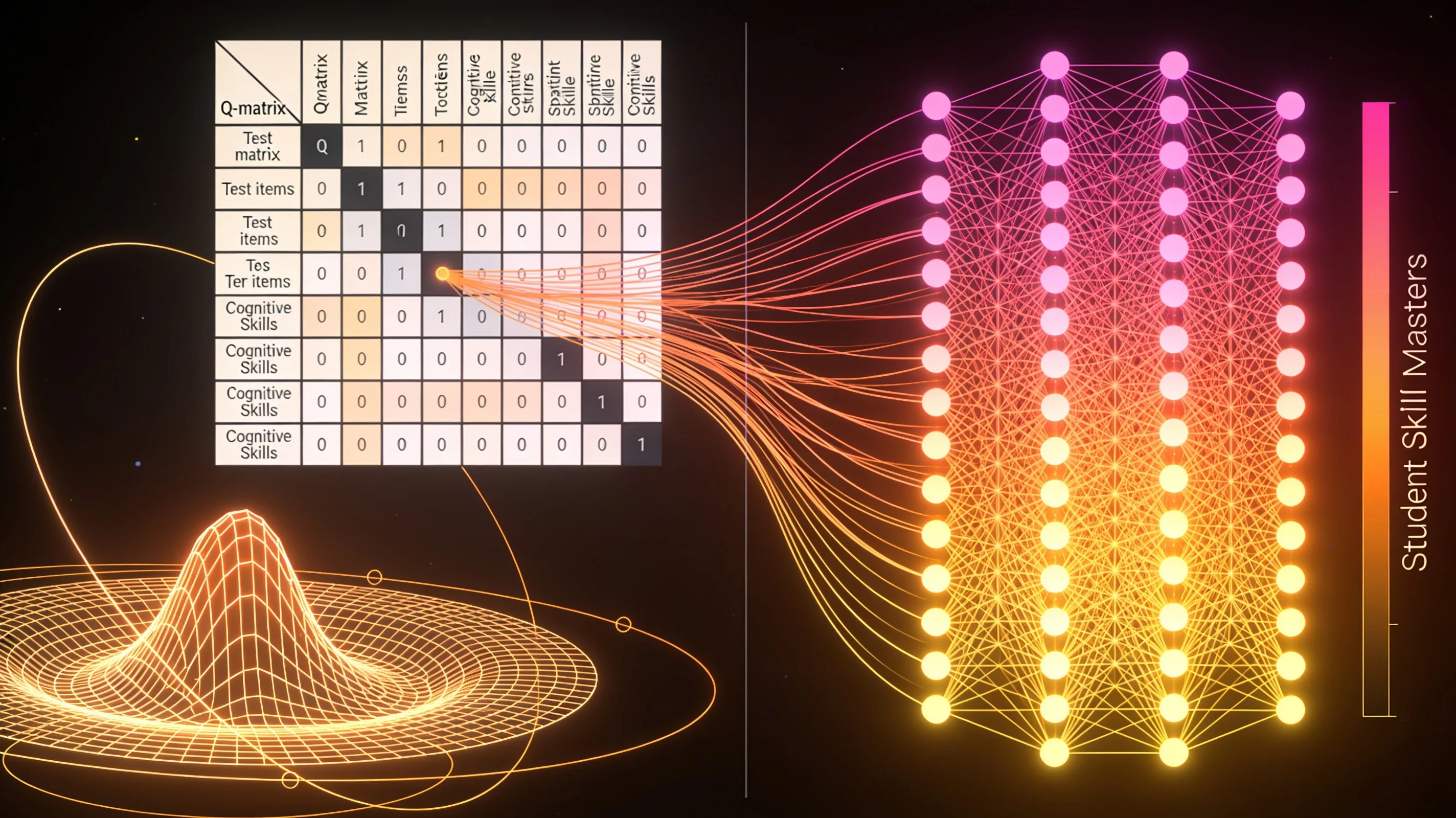
M-QCDNet is a multilayer neural network architecture that embeds the Q-matrix—a psychometric structure mapping test items to cognitive skills—directly into the model's layers. The approach addresses a longstanding tension in educational AI: neural networks excel at prediction but lack the interpretability that teachers and psychometricians need to diagnose student mastery. By structuring the item-skill relationship as a hard prior and adding an L2 penalty to suppress activations outside the Q-matrix, M-QCDNet keeps latent skill profiles aligned with cognitive theory while preserving the representational power of deep learning. The preprint, posted this week on arXiv, introduces new alignment-based evaluation metrics that quantify how well predicted skill activations match item-level skills.
The practical payoff is early detection of learning difficulties and mastery-based interventions grounded in interpretable skill profiles. Traditional cognitive diagnostic models offer transparency but struggle with complex item-response patterns; unstructured neural networks handle complexity but produce black-box outputs that educators can't act on. M-QCDNet's hybrid design aims to deliver both: the predictive lift of a neural architecture and the diagnostic validity of a Q-matrix-constrained latent space. The loss function explicitly balances prediction accuracy against structural alignment, making the tradeoff between flexibility and interpretability a tunable hyperparameter rather than an either-or choice.
The paper positions M-QCDNet as a step toward interpretable, fair, and actionable AI in education, but the architecture's real-world performance on large-scale assessments remains an open question. The preprint includes simulation results and small-scale validations; what's missing is evidence from operational testing environments where item banks are large, Q-matrices are noisy, and student populations are diverse. The next release should include benchmark comparisons against both classical cognitive diagnostic models and state-of-the-art neural diagnostic models on public datasets, along with ablation studies that isolate the contribution of the Q-matrix embedding versus the penalty term. If those numbers hold, M-QCDNet could become a reference architecture for any assessment system that needs both prediction and explanation.


