

AdaJEPA adapts world models mid-inference with single-step gradient updates
AdaJEPA from Meta AI and University of Toronto performs test-time adaptation in closed-loop control by updating visual encoder and dynamics predictor parameters in a single gradient step per cycle, using executed actions as self-supervised signal.
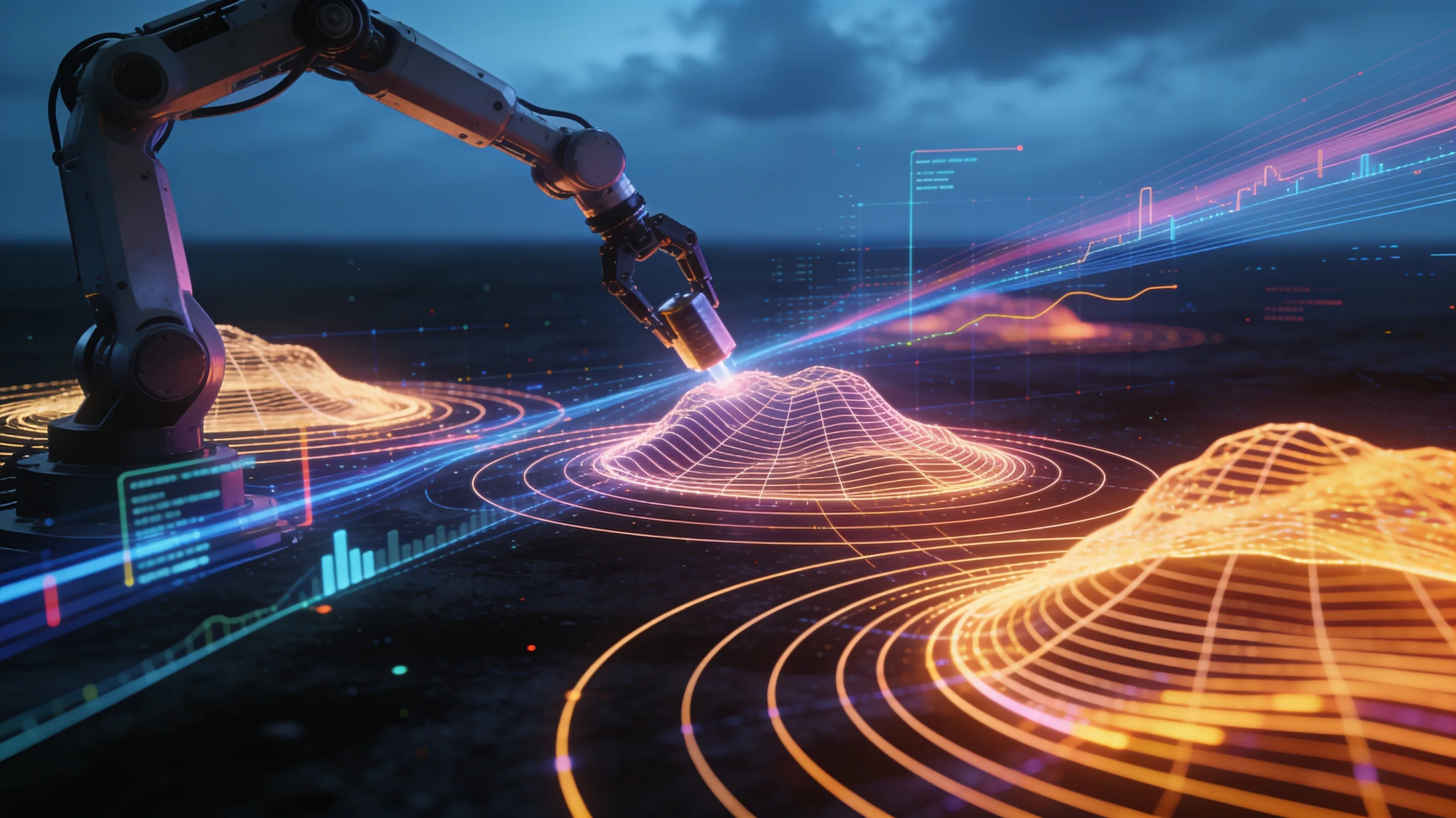
AdaJEPA is an adaptive latent world model framework from researchers at Meta AI and the University of Toronto that performs online adaptation during inference in closed-loop model predictive control. Released this week on arXiv, the system updates a selected subset of visual encoder and dynamics predictor parameters in a single gradient step per control cycle, calibrating the model to new environment conditions on the fly. The approach uses executed actions as a self-supervised signal, requiring no reward labels, expert demonstrations, or offline retraining.
Traditional latent world models remain frozen during deployment, failing when test-time distribution shifts occur — changes in physics, environment geometry, or visual noise. AdaJEPA breaks that static paradigm by enabling lightweight, sample-efficient continuous adaptation. The method updates only a small fraction of parameters (for example, the final transformer block and encoder projection layer) using a tiny buffer of five transitions, adding just 10–30 milliseconds of latency per planning step on a single GPU. In simulated manipulation and locomotion tasks, this minimal overhead delivers substantial robustness gains when friction, lighting, or noise changes mid-episode.
The framework builds on Joint-Embedding Predictive Architectures (JEPAs), which learn latent representations by predicting future embeddings rather than raw pixels. AdaJEPA extends that foundation with a test-time adaptation loop: at each control step, the agent observes the outcome of its last action, computes a prediction error in latent space, and backpropagates through the selected parameters. Because the update is self-supervised and action-conditioned, the model can track environment drift without human intervention. Evaluation on DeepMind Control Suite and Meta-World benchmarks shows that adapted models recover performance even when test conditions deviate sharply from the training distribution.
The preprint, code, and project site are all public. What remains to be seen is how the method scales to high-dimensional visual inputs in real-world robotics, where sensor noise and occlusions are less predictable than in simulation. The next milestone should clarify whether the single-gradient update remains stable under longer-horizon tasks and whether the parameter selection heuristic generalizes beyond the transformer architectures tested here.


