

LTX Director bridges Blender staging with diffusion-based video rendering
A new tool lets filmmakers stage scenes in Blender and render them through generative video models, using depth maps and motion vectors instead of text prompts to control camera, lighting, and character movement.
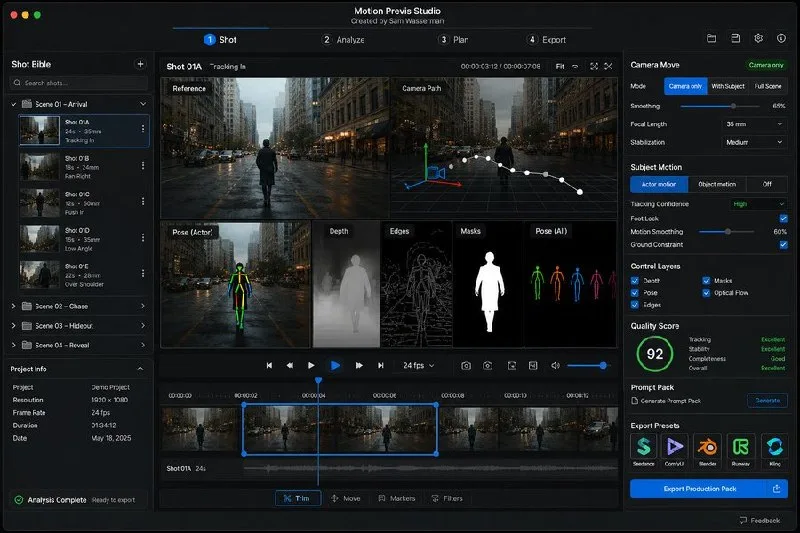
LTX Director is a blocking-to-video tool that lets filmmakers stage rough scenes in 3D software and pipe them into generative video models. The workflow mirrors traditional previsualization: block out characters and camera moves in Blender, export depth and motion data, then feed that structure into a diffusion model like LTX or Sidan to render final frames. The approach sidesteps the text-prompt problem — describing camera dolly speed, lens focal length, and character blocking in natural language has always been a losing game.
The shift reflects a broader reckoning in the video-generation community. Text-to-video models can produce striking one-off clips, but controlling dozens of moving entities — characters, lighting rigs, focal planes, shadows — through prompts alone doesn't scale. Director-focused tools are now leaning on depth maps and motion vectors inherited from traditional pipelines, the same control signals that drove ControlNet's success in still-image workflows. LTX Director joins a wave of software betting that the future of generative video looks less like "type a sentence, press generate" and more like "stage it in 3D, let the model handle texture and style." The tool targets LTX, the open-weight video model released by Lightricks in late 2024, which runs locally and supports the uncensored workflows that third-party software needs for predictable output.


