

GraphPFN wins ICML 2026 best paper for synthetic-graph pretraining
Yandex Research's GraphPFN took Best Paper at the ICML 2026 Graph Foundation Models workshop, demonstrating in-context learning and fine-tuning on millions of synthetic graphs before transfer to real datasets.
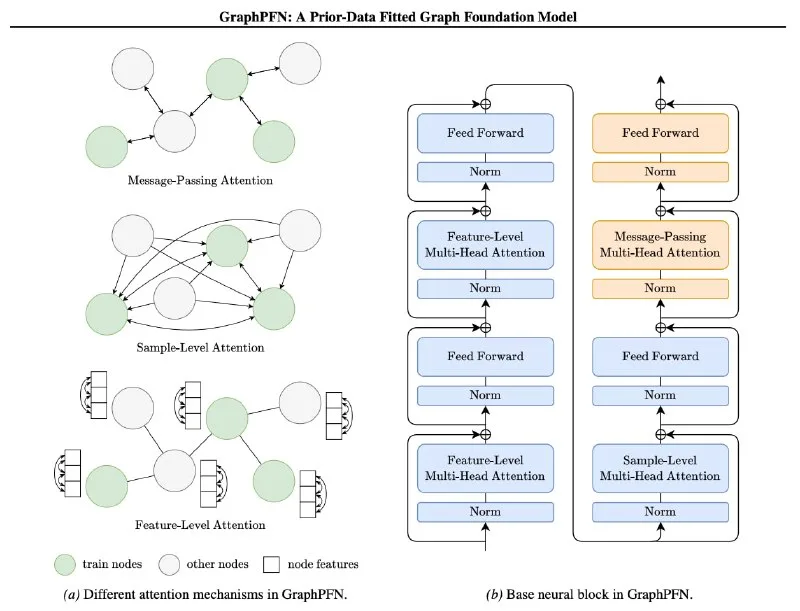
A graph neural network model pretrained on millions of synthetic graphs has won Best Paper at the ICML 2026 Graph Foundation Models workshop. GraphPFN, from Yandex Research, extends the Prior-Data Fitted Networks (PFN) approach to graph-structured data, then applies that pretraining to real-world datasets through in-context learning or fine-tuning.
The workshop itself focused on the shift from task-specific graph models to universal graph foundation models — the same paradigm shift that has reshaped language and vision AI over the past three years. Where transformer-based language models learn from billions of tokens of text and vision models train on hundreds of millions of images, graph machine learning has historically struggled with data scarcity. Real-world graph datasets are often small, domain-specific, and expensive to label. GraphPFN's approach sidesteps that bottleneck by generating synthetic training graphs at scale, teaching the model structural patterns and relational reasoning before it ever encounters a real dataset.
The Yandex Research team tested GraphPFN across a wide range of real graph benchmarks and reported state-of-the-art performance among the baselines they evaluated. The model supports both in-context learning — where it adapts to a new graph dataset without parameter updates, similar to few-shot prompting in language models — and traditional fine-tuning. That dual capability mirrors the flexibility that has made foundation models dominant in other domains, where a single pretrained checkpoint can be adapted to dozens of downstream tasks with minimal additional training.
Graph neural networks power recommendation systems, drug discovery pipelines, social network analysis, and knowledge graph reasoning. The cold-start problem has historically limited their generalization: a model trained on molecular graphs rarely transfers well to citation networks or protein interaction graphs. By learning priors from synthetic data, GraphPFN aims to solve that transfer gap the same way BERT solved it for text and CLIP solved it for vision. The win at ICML 2026 signals growing momentum behind graph foundation models as a path toward generalizable, cross-domain graph reasoning.


